The Art That Fades Into You.
Post Shift Reflections on the Fifth Dimension of Art, Appetite, and the Culinary Awakening
By Florencio Yllana
For most of my life, I considered myself a fine artist who had escaped the restaurant industry. As an adolescent, I spent countless hours working eight-hour shifts in restaurants, immersed in the relentless machinery of food service. The cleaning, the preparation, the repetition, the seemingly endless demands coming from every direction. It was exhausting, at times genuinely traumatic, and I made a solemn promise to myself that I would never return to that world. And yet, here I am, approaching half a century on this planet, willingly walking straight back into the kitchen. The irony is delicious. Somewhere beneath those memories of adolescent servitude, another memory had been patiently waiting to resurface. A much older and more innocent one: the childhood joy of preparing food for my family and friends. The pleasure of assembling ingredients, arranging a plate, experimenting with flavors, and watching someone genuinely enjoy something I had made with my own hands. It wasn’t the cooking I had hated. It was the labor without love.
And now, after decades devoted to painting, sculpture, installation, performance, and the many unpredictable manifestations of contemporary art, I find myself rediscovering the culinary arts as perhaps one of the most intimate forms of artistic expression imaginable. During my years at art school, I explored the concept of four-dimensional art, where time becomes an essential element of the work. But cooking has led me to imagine something beyond that. Culinary art, to me, is five-dimensional art. Think about it. It engages virtually every sense. The visual composition of colors and forms. The olfactory intoxication of spices and aromatics. The tactile experience of textures and temperatures. The extraordinary architecture of taste. Even the soundscape,the ASMR, the rhythmic chopping of vegetables, the hiss of oil meeting a hot wok, the crackle of something becoming beautifully crisp. An entire symphony of sensory experiences, unfolding in real time.
And then comes the extraordinary part. Unlike a painting, sculpture, or installation, this artwork literally enters your body. You consume it. You surrender to it. You allow the artist’s creation to become, however briefly, a part of your own physical existence. And eventually, of course, it exits you. There is something wonderfully absurd, profoundly intimate, and almost metaphysical about that transaction. When someone sits down at my restaurant, they are placing a peculiar kind of trust in me. They are accepting my imagination, my experimentation, my interpretation of flavors, and ultimately allowing my artwork to become part of themselves. What greater act of artistic acceptance could there be?
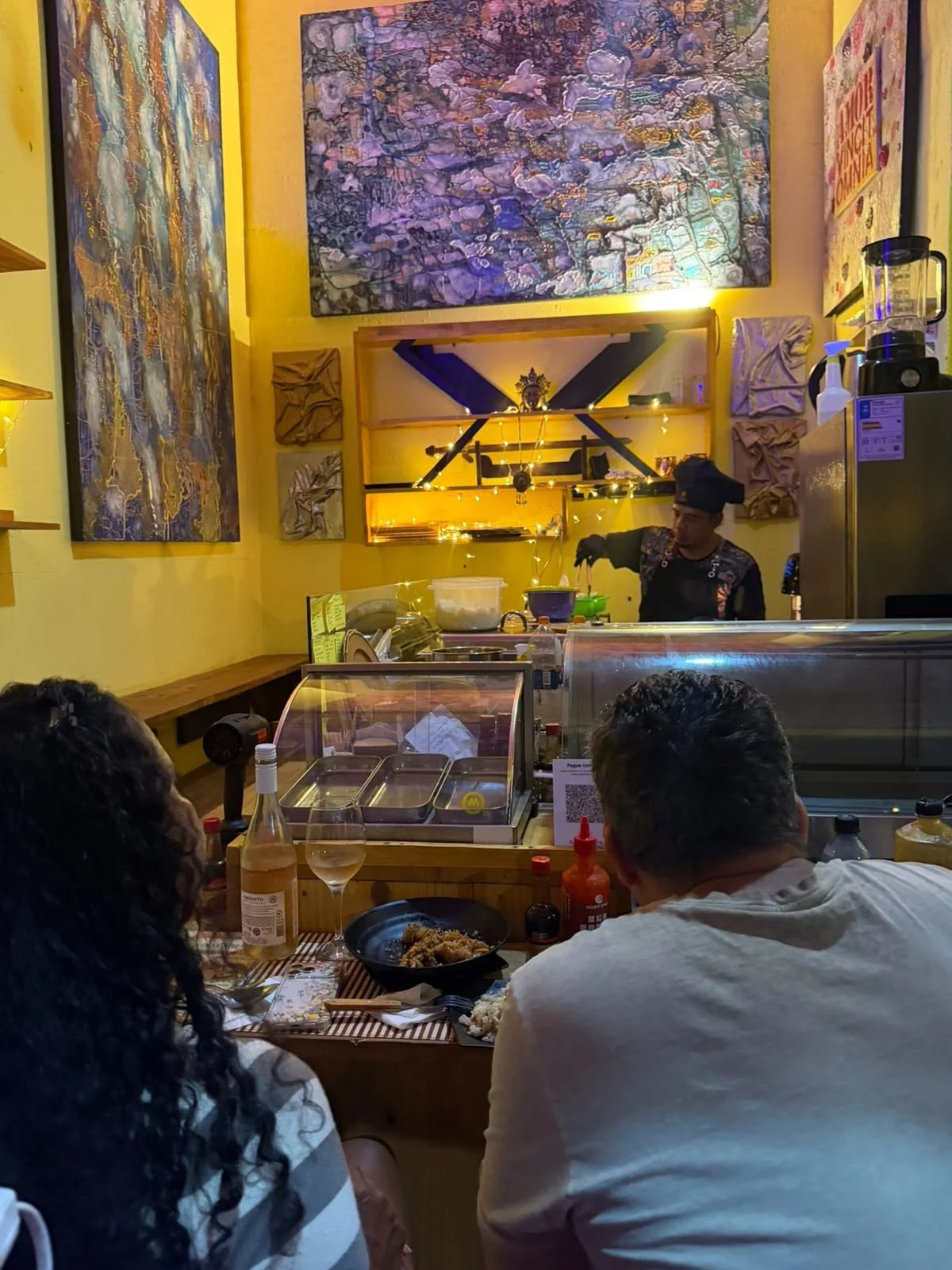
I have also begun to see restaurants differently. When I walk down a street lined with restaurants, I no longer see merely a collection of businesses competing for hungry customers. I see a street filled with art galleries. Each kitchen is a studio. Each chef is an artist. Each menu is an exhibition. Each dish is a temporary masterpiece, meticulously composed, presented, experienced—and then destroyed by the very act of appreciating it. And this is where the concept of the pop-up restaurant becomes particularly fascinating to me. Throughout my artistic career, I have approached exhibitions as temporary manifestations of an idea. I have organized and participated in pop-up galleries, transforming spaces into fleeting environments where artwork, atmosphere, and audience converge for a limited moment in time. There is an opening, a period of existence, and inevitably, a closing. The exhibition disappears. The space returns to its former identity. What remains are memories, impressions, documentation, and whatever emotional residue the experience has left behind. Why should a restaurant be any different?
In fact, the pop-up restaurant may be one of the most complete expressions of this philosophy. It is an exhibition that can be inhabited, smelled, tasted, touched, heard, and ultimately consumed. For the artist-chef, the menu becomes a rotating body of work. The kitchen becomes both studio and performance space. The dining room becomes a temporary installation, and the customers become willing participants in an artistic experience. Each evening is a new performance. Each service is another interpretation. No two dishes are ever entirely identical, just as no two performances are ever exactly the same. And like any exhibition, the pop-up restaurant has its own limited lifespan. It arrives, it exists, it evolves, and eventually it vanishes. There is an extraordinary freedom in that impermanence. The artist is not obligated to create something permanent, nor to repeat the same exhibition indefinitely. The menu can change, the concept can evolve, and the entire experience can be dismantled and reimagined somewhere else. The restaurant itself becomes an ephemeral artwork, while every dish is an ephemeral artwork within it. A temporary exhibition of temporary creations.
There is something almost Buddhist about this impermanence. At Burning Man, there is a philosophy of Leave No Trace. In the culinary arts, this becomes almost unavoidable. A beautifully prepared dish exists for only a fleeting moment before disappearing forever. Perhaps the most ephemeral art installation imaginable. And unlike the conventional art world, where gratification can be delayed for months, years, or an entire lifetime, the response here is immediate. You watch someone take that first bite. You see their expression change. You witness their pleasure, their surprise, their curiosity. Sometimes they close their eyes. And in that small, unguarded moment, the entire purpose of the artwork becomes clear.
There is also something about the atmosphere of a small restaurant that reminds me of those wonderfully understated Japanese films and series, like Midnight Diner: Tokyo Stories, where seemingly ordinary rituals become poetic meditations on human existence. The quiet preparation. The repetition of simple gestures. The intimate exchanges between strangers. The comforting theater of everyday life. And suddenly, the adrenaline of cooking before an audience. There is a performance unfolding, whether anyone recognizes it as such or not.
With Estrela do Oriente, my little culinary experiment in Arraial d’Ajuda, I’ve chosen to explore the flavors of Asia, not because I claim mastery over its vast culinary traditions, but because these are the flavors I personally crave after a session of painting. Brazil already has a remarkable relationship with Japanese cuisine, thanks in great part to its rich history of Japanese immigration. Sushi and yakisoba have become familiar and beloved expressions of that cultural exchange. But Asia is an immense universe of flavors, and I wanted to open a few more doors. Thai, Indian, Korean, Filipino, Chinese, Japanese, Vietnamese, a sprawling constellation of culinary traditions, each with its own colors, textures, aromas, and philosophies. To me, spices are pigments. Sauces are mediums. Ingredients are materials waiting to be transformed. And fusion is simply another form of artistic experimentation. I have spent my career resisting rigid boundaries between disciplines, cultures, and methods of expression. Why should my kitchen be any different?
In many ways, Estrela do Oriente is simply my latest exhibition. Only this time, the walls are not necessarily covered in paintings, the installations are assembled on plates, and the audience is encouraged to eat the artwork. And when this particular exhibition eventually closes, as all exhibitions must, perhaps another will emerge elsewhere, with an entirely different menu, atmosphere, and concept. That possibility excites me enormously. Ultimately, opening this restaurant has revealed something unexpected about my own artistic journey. Perhaps I haven’t abandoned fine art to become a cook. Perhaps I have simply discovered another canvas. One that sizzles, steams, crackles, perfumes the air, and occasionally burns my fingers. One that asks the viewer not merely to observe, but to participate. To surrender. To devour.
And perhaps that is the beautiful contradiction at the heart of this peculiar new chapter of my life: After spending decades creating art that I hoped would remain in people’s minds, I have discovered the extraordinary satisfaction of creating art that disappears into their bodies. And somehow, in its disappearance, leaves something behind. A memory. A sensation. A craving. A little piece of me.
Bon appétit.
— Florencio Yllana
Fine Artist & Accidental Culinary Alchemist
Estrela do Oriente , Arraial d’Ajuda, Bahia